CHAT WITH MICHELLE ANDERSON PICARELLA

Shelly

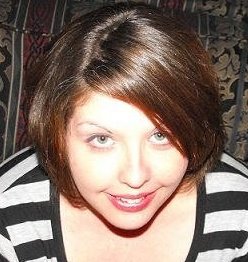
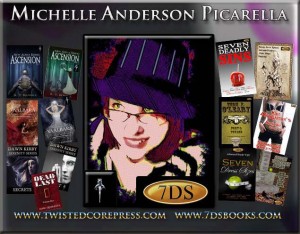
Michelle Anderson Picarella is the C.E.O. & Founder of 7DS Books and Twisted Core Press, L.L.C. She and her partners run 7DS Books as an invitation-only anthology collaboration helping dedicated authors build their platforms with new and unique themed titles as well as bridging authors together for successful cross-promotion. Michelle is also a published author, former director of publicity, author advocate and proud indie supporter.

Time to chat with Shelly!

What is 7DS Books?

7DS Books is an invitation only short story collaboration publishing imprint of Twisted Core Press. Along with my partners, A.T. Russell and Daniel Picarella, we create unique themes each title and personally invite authors we have met through social media to join. It is instant author networking when placed in a private chat with seven authors. They help each other with pointers and beta reads before it hits our editor. After print, they are connected with every author on every previous 7DS title with means for cross-promoting, blog tours, getting together for literary events, etc. We truly believe the best way to succeed in the world is to work together. We want to do what we can to help authors connect, promote, and build their platform. A new phase of 7DS will be coming into play in 2014. We are very excited about this and will announce the new chapter of 7DS soon. Currently, our popular sellers are Seven Dress Sizes, Seven Deadly Sins II, and Linger.
TwistedCore

What are the special challenges in running collaborations?

I think the hardest part has been working in a close group with so many brilliant and talented authors. Overall, it is great and the outcome shows this. But, sometimes when multiple people come up with fantastic ideas that do not flow into each other, it is hard to only pick which route is best if we cannot mesh all the ideas together.

Have you ever written characters that you truly despise?

Yes. Most certainly. I like darker tales. I love the depth and layers behind the most despised characters. It is pointless to ask why a person is good. Everyone wants to know why someone is bad.

Were you “born to write” or did you discover your passion for writing later in life?

As far back as I can remember, I was writing stories. Even when none of my words made sense to anyone else, my jumbled crayon rambles were my life. I remember first getting a reaction from my writing in second grade when I wrote about self-sacrifice in order to save a turkey from the pilgrims. I loved coming up with the story. That was easy. Predicting how readers will react is the fun part.

Do you have any advice to a new author if they asked you whether to pursue the traditional route to publishing or to start out as an independent writer?

I am a firm believer of publishing matches. I wish there were a place for matching authors with publishers like a dating site. It is a business, but it is a relationship. An author is handing their dreams over to a publisher and that publisher is investing hope, faith, time, and finances into this work. I do not think one route is better than the other. I see indies run neck and neck with trads. I think research is the best key for new authors. We assume so much when we are new and then we listen to people that appear to know the gospel but as much as this industry is changing, the only thing that remains gospel is the need to provide a quality product. This can be obtained using either route. Going trad does not mean you will be in a brick and mortar store. Being indie does not mean you are going to have the best selling ebook. Either way, an author has to work. This is a business. The difference between writing a book and being an author is work and growth. The route you choose to become an author is just that… A choice.

What do you like best about the books you read? What do you like least?

I am an indie book fanatic. Nothing against traditionally published material, but most trad publishers know exactly what they are looking for before it hits the slush. Indie and self-published books tend to carry a flare and flavor not as predestined in many (not all) cases. I love main characters that break the common stereotype of what a main character should be. I love the button pushers. Many people fuss at me for my limited attention span with books. If you don’t grab me within the first few pages and show me something refreshing and bold, you’ve lost me. Minus those indie/self published authors that attempt to mimic the mainstream, odds are good, if you pick up an indie read you are likely going to see something with that boldness. What do I like the least? This is something I see commonly no matter where the book comes from… the main character is a female, likely white, she has a tough life in one way or another but at the core, it is good. She is faced with a challenge that likely holds the fate of many other people around her. Sometimes, it is life and death. Either way, amongst the dire complexity of pressure this female MC must tackle, she also has to choose between two guys. Oy with the love triangles! Kill it with fire!

What have you done to market books and what did you find the most effective? The least effective?

The most surefire way to market is and always will be word of mouth. I could speak of each social media site, ads, publicists, etc.. but the difference in the literary world and a reader: A reader loves hearing someone they know talk about a book. If a reader is inspired by a book or even disgusted by a book, it is the passion in either direction that creates a craving for new readers to seek this book and their desire to derive their own opinion. I’ve seen ads, commercials, book trailers (not in the least saying they are pointless. Keep doing that!) but the books I’ve had to read came from feeling the passion brewing from a reader. The best way to pour gasoline on that fire is to cross-promote. This is a core reason we run 7DS Books; instant pool of cross-promoters, if utilized properly. You can scream the word of your book on every single social media outlet and maybe sell a book or two, because of course you think it is a great read. A publicist can do it for you and gain you some new readers, but that burns out quickly when they are also claiming one hundred other books are also the best book of the year. Now take an author, published, well read and already reached their connections and family with their word of their book and suddenly, they are reviewing your book and telling Aunt Sally and Bob from the office about this great new author they’ve discovered. Well, wow. Aunt Sally just told everyone in her book club, and they told their friends, and those friends mentioned it over dinner and Bob is at the table next to them and that title sounds familiar so he brings it up to his wife and she has PTA after dinner and….see what I am saying? Just like air is always going to be the best thing to breathe, word of mouth is always going to be the “it” thing in marketing.

Now the worst: BAD Facebook event parties. You can do this well but most people do not. People love free things… “Swag”…but how are you going to have a Facebook release party for your book and give away something to the first person that knows the drink a character they’ve not heard of is sipping at the bar in chapter thirteen of the new release? What is that about, authors?  If you want to thank your beta readers, just send them the swag, don’t invite us to the event to see it. Nobody wants to buy your book after that. Also, keep it family oriented if you want participants. Even if it is a gritty down and dirty erotica, nobody is going to like an X-rated photo or comment with the best caption with their family and friends online to see it in the newsfeed. Common sense goes a long way in Facebook events.

Trains, planes, automobiles, or boats?

Trains. Always a train. The kid in me comes out when I get the chance to travel by train. Somehow, I always end up in the most random of conversations with these fantastic strangers. I even have train buddies on my social media to keep up with them and we message each other to see if the other is traveling near dates of upcoming trips. LOL. The chill when traveling overnight, the personalities you come in contact with, and seeing the world fly by outside your window are my favorite parts. Now I want a train trip. Where are we going?

What’s your biggest pet peeve?

People scratching heads. I am a total lice phobic. I can handle spiders, bees, mice.. anything (maybe not snakes and alligators so much) but the thought of lice makes me cry. I hate the thought of itching. I will count how often someone scratches and after that third one, I will offer to check your head. This tends to be a bit more awkward with strangers.

What are three things you think we can all do to make the world a better place?

Three: Walk away from agenda: Embrace the differences in people. We tell our kids not to bully every single day just to turn around and bash anyone that does not see things our way.

Two: Reboot and Recharge: Never allow timidness with new ideas, feelings, beginnings, or dreams. I mean this in every aspect of daily life.  We can take this from the business and marketing aspect and approach sales or job performance with a blank page. Your friends and family- we all grow and change; take time for a dinner and get to know the people you’ve all grown to become since meeting. Take it to the polls and stop voting for the lesser of two evils- collaborate a majority write-in candidate that could really make some changes.. Maybe it is you! Take some you time. As much as it helps to get to know the people your loved ones have become, when is the last time you escaped and bonded with the you that you’ve become throughout the years?

One: Love: This one is the most simplistic human operation and we allow ourselves to complicate it. Love has a million degrees. Love strangers. Open doors. Nod to a passerby. Make a silly face at a kid. Tip an extra dollar. Love acquaintances. Congratulate. Compliment. Offer condolences when needed. Friendships are love. Listen. Talk. Laugh. Take time to openly speak the words of appreciation for them just existing as a part of your life. Love the one that holds your heart the dearest. This is not about an obligation or a responsibility. When the love is right, it doesn’t feel like such a chore. Love is never a debt. Love flourishes freely where love grows. Maybe there is not just “the one” maybe you have a series of “the ones” until you find the final one. Each love helps you grow and you do the same for them. Appreciate the love even after it forms into a different type of love; you never un-love someone. Your heart just rearranges. Know when it is time to admit a love has altered into something different but never pretend a love is an apple tree when it has grown into a weeping willow. Both are beautiful, but one has the fruit of life and one has the shade of the past. Embrace them both, differently.  Family: Family is a bond we never ask for. Our parents won’t be around forever and as you age, you will become them. When they are no longer around, you will see them every time you look in a mirror and every missed lunch or shrug with lack of interest will haunt you. Sometimes, just telling them you love them will end up being a favorite memory. Your kids– the best way to love your kids is to show them how to live. Kids learn everything by example. They learn and live just as we show, not as we say. So chase those dreams, so they will. Take care of yourself, so they will do the same. Educate yourself, educate them. Cuddle them. Laugh with them. Be completely silly in public. Talk to them, not at them.. and your grandchildren will be in great hands. Above all ways to love your kids and the most important way to love you must start with one thing. Love yourself. If you don’t learn to love yourself for everything you are in darkness and light, you’ll never truly show love to anyone else. The end.

 CONNECT WITH MICHELLE

Facebook

Twitter

Goodreads

LinkedIn

Blog

Google+

Twisted Core Press official site

7DS official site


FIVE WAYS TO STAY SANE AS A WRITER


Five Ways to Stay Sane as a Writer – (by an author who lost her sanity a long time ago)

1.      BE PATIENT: If you’ve just written a novel, you may, like others, be eager to share it with the world, even though the prospect of doing so can be as daunting as it is exciting. Unfortunately, in their excitement, many authors query agents or self-publish way before their manuscripts are ready.

Take a deep breath. Relax. Remember, it’s much better to wait to put out your best work than to rush and put out a sloppy version of what could have been really good. Take time to edit and rewrite, then have a professional editor work on it. Putting out your best work will be a great boost to your mental health. Kicking yourself for not waiting isn’t helpful. Besides, you might hurt yourself.

YogaCrazyWriter

2.      COMPETE WITH YOURSELF FIRST: It’s easy to look around to see what everyone else is doing and wonder why your books aren’t selling as well as Joe Author’s books are. While you can learn a lot from watching how successful authors do things, don’t let the success or failure of others take over your thoughts. Don’t try to outwrite other authors; instead, outwrite yourself. Remember that you are a unique product. You’re not a carbon copy of anyone else and you shouldn’t be. Compete with yourself. Be the best writer you can be.

3.      FIGURE OUT HOW YOU WORK BEST: Some writers, while crafting their masterpiece, find it helpful to share with critique groups both on- and offline, as well as with family and friends. For others, the input of outsiders during the creative process can be stifling. Will the editorial critique help you more during or after the process of writing? What works best for you? Don’t make the mistake of sharing your work with ten different people and getting ten different opinions, unless you know it will galvanize you and not shut your muse down in frustration.

4.      DON’T LET SOCIAL MEDIA CONSUME YOU:  Building a platform on social media is very important. It’s not something that you should do when your book comes out; it’s something you should do at least six months prior to publication. That said, it can be addictive, exhausting, stressful, confusing or all of the above. Find a balance that works for you. Decide what amount of time is reasonable for each platform and try to adhere to that. Use the rest of your valuable time to create your product. Balance. Balance. Balance.

SocialMediaSwarm

5.      REMEMBER THAT NO WORK OF ART IS LIKED BY EVERYONE—EVER:  There is no book, no song, no painter, no singer, no movie, no TV show, no poet, no anything that is liked by everyone. Keep this in mind as you put your work out there. In a parallel universe, we want to believe that everyone will like our work, but they won’t. Do your best, define your style, put out your best work, and your readers will come.

Tell me, what methods have you attempted to keep your sanity? Have they worked?


CHAT WITH ELLIS SHUMAN

EllisShuman-1

Ellis Shuman was born in the United States but moved to Israel as a teenager. He served in the Israeli army, was a founding member of a kibbutz, and now lives outside Jerusalem. For two years, 2009-2010, Ellis and his wife lived in Sofia, Bulgaria. Alongside working a day job in online marketing, Ellis writes frequently about Bulgaria, Israel, books, travel, and the craft of writing.

What is your latest book?

This past year has been a very exciting one for me. I self-published my suspense novel, Valley of Thracians, and it has done remarkably well. I’ve been very pleased with readers’ responses, as the book is not your typical suspense novel. Some readers have described it as ‘travel fiction’ as well as an introduction to Bulgaria, a country that few have visited, or know much about. In my novel I strongly emphasized the setting of the story. The book deals with a Peace Corps volunteer who goes missing during his service in Bulgaria. His grandfather comes to the country to track down the missing young man and ends up learning about Bulgaria’s history and culture as he travels.

I’ve been particularly excited with the reaction of Bulgarians who have read the novel. Some have claimed that it is the Bulgarian version of a Dan Brown thriller, while others said that this was the first time any international author had featured normal Bulgarian citizens in a novel. I have to admit that I made a number of small corrections in how I depicted life in Bulgaria in response to comments received from my Bulgarian readers.

ValleyofThracians

What else have you written?

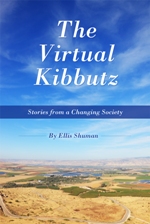
I published a collection of short stories, The Virtual Kibbutz, ten years ago. The stories were based on my experiences as a founding member of Kibbutz Yahel, in Israel’s southern desert. As part of my Israeli army service, I served on the kibbutz when it was established in the 1970s. During my years as a pioneer, I worked in agriculture – driving a tractor, picking vegetables and sorting them for market. It was amazing to see our successes in growing bumper crops of tomatoes, onions, and peppers. However, as my wife and I began raising a family, we realized that we were interested in more independence and control over how our children grew up. Also, living in the desert, so far away from our families, was a challenge. We left the kibbutz after seven memorable years, and moved to a small community near Jerusalem. I returned to the unique kibbutz way of life in my writing nearly two decades later and introduced readers to this lifestyle with the stories in my book.

Kibbutz

How much research was involved in writing your book? How did you go about it?

After publishing my short story collection, I realized that I lacked the drive to write another work of fiction based in Israel. This was what hampered my creativity for several years. And then, I was given an once-in-a-lifetime opportunity to have my job relocated to Bulgaria for two years. My wife and I made the most of our time in Sofia. We traveled extensively around the country, learning about Bulgaria’s history, culture, traditions, cuisine, and most importantly, its people. Little did I realize at the time, that everything I was experiencing was actually research for my novel.

Bulgaria is most definitely off the beaten track for western tourists, which is a shame, as its landscape is picturesque, filled with traditional villages, mountains perfect for wintertime skiing, and endless shorelines of sandy beaches. Few international authors have used Bulgaria as the setting for their novels, and Bulgarian authors are rarely translated into English, if at all. My fiction, based in Bulgaria, is therefore quite unique. Even now, three years after returning to my permanent home in Israel, I return to Bulgaria daily in my writing.

What part of writing a novel do you enjoy the most? The least?

In my day job I am an editor, and actually, editing is my most favorite part of writing a novel. I enjoy writing, but I absolutely adore editing. Editing is the stage that makes your writing come alive. With writing you create a manuscript, but with editing, you transform that manuscript into a book. As I edit, I add details to my scenes, character to my characters. Dialogues come alive during the editing process. I am currently editing my second novel and I am enjoying every step of the process.

Do you allow others to read your work in progress, or do you keep it a secret until you’ve finished your first draft? Can you elaborate?

My wife is my alpha reader, the first person who is exposed to my fiction. She is hardly an editor but can easily find mistakes and typos in my writing. I shared my first novel with my wife as each section of the book was finished. Unfortunately for her, that meant long intervals between reading the different parts of the story. With my new novel, I have already completed a quick, first draft. As soon as I finish editing the draft into something presentable, my wife will get an opportunity to read it. I will also share the novel at that stage with a number of other beta readers and look forward to their remarks and suggestions.

Are you an early bird writer or night owl? And do you have any must haves like coffee, chocolates, wine, music or something else?

I work a long day at the office with a one-hour commute in each direction. By the time I get home in the evenings, I am completely washed out, with no creativity left in my body. I look forward to weekends, but that is the time when I enjoy my family, travel, reading, and relaxation. So, when do I find time to write?

I managed to add on an extra hour to my day and I use it to pursue my creative endeavors. I leave an hour earlier each morning for work, but instead of going directly to my office, I sit down for a one-hour session at a nearby coffee house. While I drink my morning cappuccino, I tune out all the noise around me and make a lot of progress in my writing.

Were you “born to write” or did you discover your passion for writing later in life?

I was inspired to write by my father, who worked as a journalist while I was growing up. With his encouragement, I created, managed, wrote and marketed a neighborhood newspaper, going door to door asking for news of my neighbors’ summer plans, and the activities of their children and their grandchildren. Afterwards, I sold the paper at ten cents a copy. I never got rich with this childhood pursuit, but I developed a desire to write and tell stories. It would take me many years until I was able to publish my stories as a book.

What have you done to market your novel and what did you find the most effective? The least effective?

Even before I published a novel, I started a writing blog where I regularly post articles about my travels in Bulgaria and Israel, as well as book reviews and other opinion articles. I also began blogging for The Times of Israel, a leading online news source. All of this became part of my campaign to market my novel.

I published Valley of Thracians with the KDP Select Program at Amazon. Last March, in an attempt to build up readership and get additional reviews, I offered the book for free. A total of 8,900 copies of the book were downloaded in a five-day period, temporarily making the book a best seller.

In October, I reduced the price of the book for five days from $4.99 to $0.99. This time I advertised the book in BookBub. Thanks to this advertisement, I managed to sell 910 copies of the book in one week. Those authors considering BookBub should also know that my advertisement was rejected twice, and I think this is because at the time of my original submissions, I didn’t have enough reviews of the book posted on Amazon.

Please, tell us about your experiences with social media. What are your favorite and least-favorite parts of it?

I decided to focus all my marketing efforts on one social media platform – Twitter. I have never developed an author’s page for Facebook, nor have I devoted efforts into establishing a presence on Goodreads. But with Twitter I have become quite successful, with over 14,000 real followers.

My success on Twitter is due, in part, to my not marketing my books there. I never tweet to my followers, “Buy my books” but instead tweet value-added information and links to the articles on my blog and elsewhere. My followers are particularly interested in my writing tips, as I freely share all of my experiences during the writing and self-publishing process. I follow back fellow authors and writers, and actively hook up with them all the time. I have made many good friends on Twitter.

Where do you live now? If you had to move to another city/state/country, where might that be?

I live in a small community in the forested hills west of Jerusalem. It is a perfect location, not far from Israel’s international airport. My wife commutes to Jerusalem while I commute to Tel Aviv. We’re close enough to enjoy the best of both cities as well as explore the rest of the country, which, admittedly, is not very big.

I would never consider moving to another location in Israel or elsewhere. I had the amazing opportunity to live for two years in Sofia, Bulgaria, and that gave me a chance to travel around Europe. That experience also became an inspiration for my writing.

Care to brag about your family?

I have three wonderful, adult children, and all three of them live in the Tel Aviv area. My eldest daughter is married. She and her husband have two beautiful daughters. My wife and I enjoy being with our family, and especially our granddaughters, as much as we can.

What might we be surprised to know about you?

In my day job, I promote online poker. I have traveled to Manila, London, Las Vegas, and Bulgaria as part of this job, and in 2005, I played in the World Series of Poker (in a celebrity/media event). I only promote online poker where it can be legally played, so Americans, Bulgarians, and Israelis are not the focus of my marketing efforts. I sincerely believe that poker is a game of skill and adults should be free to play it whenever and wherever they want, no matter if it’s in a Las Vegas casino or in the comfort of their own home on their computer.

CONNECT WITH ELLIS

Ellis Shuman Writes (Blog)

Twitter

Valley of Thracians (Amazon U.S.)

The Virtual Kibbutz (Amazon U.S.)


CHAT WITH DOREEN COX

Dody

After a somewhat convoluted career path in various business-related and mental health endeavors, Doreen (Dody) Cox has settled into a later-in-life passion: writing. On a part-time basis, she teaches an offsite GED class of multicultural adults in one of her favorite places to be: a library. Dody lives in central Florida.

Time to chat with Dody!

I hear you have some very exciting news! Can you share it with us?

It is finally sinking in that I completed a book of fiction, a short story titled, A Sacred Journey. I’ve always been an avid reader and must admit that I’d often daydreamed about writing a book myself, but a variety of challenging career endeavors kept me occupied until now. A Sacred Journey embodies four major themes that are central to my outlook on life: first, be willing to see everything and everyone around me with fresh eyes. Second, stay open-minded as to the element of mystery that exists in our world. Third, affirm the sacredness inherent in the time of dying – beyond specific religious views. These three themes are enfolded in threads of humor, the fourth theme.

SacredJourney

How much research was involved in writing your book? How did you go about it?

Transformational in theme, A Sacred Journey is a fantasy with a touch of paranormal; it began its life as a 5700 word short story titled, Wrapped in a Long-Ago Dream. In late March, Words Unlimited featured a short story contest: a pre-made book cover was revealed and entrants had 72 hours to write a short story, any genre. As soon as Laura Wright LaRoche’s book cover was revealed, the stunning image of a figure in a red cloak standing in a forest immediately triggered a tumble of memories. My mother had favored an old red robe, and she had loved our natural world. Through conversations we’d had, I knew that death was something she had not feared. For much of my adult life, she had pestered me to write a book – any book. At the time of the contest, these memories and thoughts coalesced and a story emerged. One aspect is true – a dream my mom once had about my dad, deceased shortly after I was born.

My mother’s bout with dementia acted as fertilizer for the plot. During the end phase of her dementia, she’d often woken during the night, caught up in delusions. As her caregiver, my task had been to keep her safe. Night-time was tough; it was hard for me to handle her physically and both of us, emotionally. To my mother, the delusions were real. It was difficult to do, but I learned to let her delusions be – to acknowledge her garbled words and frantic movements, to play along until she was comforted by my validation of what was true for her. At that point, the delusion would fade and she would fall back into sleep.

Since her death, I’ve often wondered about what was going on in my mother’s mind during those delusions: who was there…where was she going. All I had gotten were pieces. I could pick out only a few of her words, guessing meanings by her gestures: the baby, people in the closet, her brother outside. So writing the story was cathartic and, mid-way through the 72-hour period, I had an illuminating thought: if I had been able to understand my mom or been less tired, I’d have been entertained by a great story. Wrapped is the story that I finally wrote for my mother. Much to my delight, my story was one of the runner-ups.

After the contest, an author whose writing style I admire, and whose stories are favorites of mine, did a read-through of Wrapped. Offering feedback and encouragement to enhance the story, Julia Hughes’ comments stayed with me for several months. Although working on another story, Wrapped kept intruding until I laid aside the current work in progress. The 5700-word story turned into one with over 14,000 words. During the course of the re-write, Wrapped came alive for me in an even more personal way; it became a story I was writing for me.

We all know the old saying; you can’t judge a book by its cover. This is true. However, how much importance do you place on your book cover design?

Similar to a dog’s reactions in Pavlov’s experiments, my eagerness to open a book is enhanced at the sight of its cover. Laura Wright LaRoche at LLPix.com designed my fabulous cover.

Do you dread writing a synopsis for your novel as much as most writers do?

Truthfully, yes, because it’s another task to complete. Yet the challenge of capturing the essence of my story in a few paragraphs is motivation enough. As an avid reader, the synopsis of a story is often what prompts me to purchase a novel; once my curiosity is whetted, I’m in. Writing a synopsis for A Sacred Journey actually gave me a bit more perspective on my own story.

What else have you written?

My first published book, Adventures in Mother-Sitting, is a memoir of the three years I spent as full-time caregiver to my mother. I was working as a group counselor at an alternative school for at-risk students when my mom’s physical and mental condition deteriorated. Although my decision to let go my job, income, health insurance and identity was difficult to make, I did not hesitate to make the choice – the bond with my mother had always been strong. The dance that she and I had with her dementia challenged me in ways I had never imagined. The word, “adventures,” in the title depicts the experiences I had. With dementia present, the daily care habits and reactions of my mother were so unpredictable. Even more challenging to handle were the unpredictable eruptions of my own emotions – unwanted meltdowns, embarrassing at the time. The last year of my mother’s life – when she was ‘my child’ and approaching death – was incredibly tough yet so amazingly rich for me, emotionally and spiritually. Being my mother’s care bear was like a final gift she gave to me. My gratitude became expressed when I fulfilled her long-held wish for me: write a book. I often sensed her presence, guiding me as I wrote.

AIM_Final_June_9_2014_COVER

Were you ‘born to write’ or did you discover your passion for writing later in life?

Writing sections of and editing technical manuals and business proposals – years ago – is the closest I’d come to writing a book until now. During mother-sitting, scribbling in a journal was merely a way to keep me sane, an outlet that steadied me. After my mother died, I found a cache of letters that I had written to her while in college and, later, from wherever I happened to be. As I reread the letters, old memories came vividly to life and an urge to try my hand at writing a book took hold. This was several months after my mother had died. I was struggling to make it through my days and needed a new focus to temper the onslaught of grief over not only the loss of my mother, but also the loss of my role as caregiver. So I sat down at the table one day, tore out the pages from my journal, and began.

Some authors, like me, always write scenes in order. But I know some people write scenes out of order. How about you?

My writing approach is one that I term as a “jigsaw puzzle process.” When mother-sitting, my mom read to me from children’s books, The Bobbsey Twins for one. Because of dementia, her speech was quite garbled and she’d often read the same sentence over and over. Her affect, though, was priceless – animated and infectious. Surprisingly, it was doing 1,000-word jigsaw puzzles while she read that gave me contentment.

In a strange way, my puzzle activity set the stage for my writing. For both the memoir and the novelette, writing was akin to doing a jigsaw puzzle: fit this segment here and that one there – add, delete, and adjust until finally, the segments had a smooth flow. This is my favorite part of writing: juggling the segments into chapters and the chapters into a satisfying whole. When I step out of the way, stop trying to force a piece to fit, my inner muse takes over; this energetic sense of flow is infectious. I no longer do jigsaw puzzles; instead, I write.

What part of writing a novel do you enjoy the most? The least?

To be sure, there were differences between how I wrote my memoir and the fictional story. In my experience, however, there were commonalities to both; the first, of course, was to sit down and write. Getting started is still my least favorite part of writing. Once involved, however, the process of writing the memoir and the story turned into a fascinating adventure.

Is it important for you to know the ending of a book before you write it? The title?

My writing approach is one that I term as a “jigsaw puzzle process.” When mother-sitting, my mom read to me from children’s books, The Bobbsey Twins for one.  Because of dementia, her speech was quite garbled and she’d often read the same sentence over and over. Her affect, though, was priceless – animated and infectious. Surprisingly, it was doing 1,000-word jigsaw puzzles while she read that gave me contentment.

In a strange way, the puzzle process set the stage for my writing. For both my memoir and the novelette, writing was akin to doing a jigsaw puzzle: fit this segment here and that one there – add, delete and adjust until finally, the segments had a smooth flow. This is my favorite part of writing: juggling the segments into chapters and the chapters into a satisfying whole. When I step out of the way, stop trying to force a piece to fit, my inner muse takes over; this energetic sense of flow is infectious. I no longer do jigsaw puzzles; instead, I write.

Do you allow others to read your work in progress?

I didn’t think that I would ever allow anyone to read my work as it was being written. Writing the memoir was very cathartic, so I kept it to myself until it was complete. When I decided to enhance my short story, though, I discovered that there was merit in having a trusted friend, another author, read chapters that were near completion. In that case, I followed the urging of my gut. Trust of another’s opinion is the key if my gut urges me to ask for it. Basically, I plan to remain open-minded.

What do you like best about the books you read?

I have always admired authors of various genres who have the ability to weave words in a way that pulls me into a novel. The stories I enjoy have a tone, a quality beneath the storyline that sets up a hum in me. When it’s engaged by a story, the editor in my head disappears (and I do love to edit). My hope is that readers resonate in some way with my story.

What’s the best gift you’ve ever received?

On a whim, in my late thirties, I quit my job as a hospital recruiter in order to head out West and hike the national parks of Utah, Arizona, and New Mexico. In an old Fiat convertible, I set off in July on a sabbatical to find myself…I was at some crossroad. The best gift was 100% acceptance by family, friends, and coworkers. This was before the availability of cell phones, and I would be on my own. No one tried to talk me out of taking the trek. It is also the best gift I’ve ever given myself. I was gone for three months.

What is the coolest surprise you’ve ever had?

In my mid-forties, a close friend gave me the coolest surprise ever: a free ticket to skydive for my birthday. The day of my birthday was sunny, in the mid-70s and gusty. It took most of the day before the winds died down enough for my group to go up and make the dive. As luck would have it, a group of professionals were gathered for a day of fun. They put on quite a show, ramping up my excitement. We finally got the go-ahead, so around 3:30 in the afternoon, I jumped out of the plane and screamed in absolute delight! The freefall phase was my favorite – it felt as if I were flying, not falling. The sensation was so glorious that I almost forgot to pull the cord that would pop the chute. Luckily, this was a tandem jump. The guy on my back tapped my shoulder, I pulled the cord, and we floated safely back to earth.

If you could be invisible for a day, what would you do?

One of my favorite words is “perspective,” and I’ve been told that my middle name is “curiosity.” If I could be invisible for a day, an expectation is that my judgments and sensibilities would be tamped down. There is no doubt in my mind that I would head to various hot spots in our world, for example: neighborhoods where gangs clash, sections in the Middle East and Africa where rebellions against tyrannical rule are occurring, and refugee camps where displaced persons struggle to survive. Although there is no clear way to walk in another person’s shoes, see circumstances through their eyes, being invisible – walking beside them without judgment – would be the next best thing.

CONNECT WITH DODY

Amazon: Adventures in Mother-Sitting

Amazon: A Sacred Journey

Smashwords: A Sacred Journey

Treasured Encounters Blog

Facebook

Twitter


CHAT WITH LLOYD LOFTHOUSE

Lloyd

Lloyd Lofthouse served in the Vietnam War as a U.S. Marine; then taught in the public schools for thirty years. He lives outside of San Francisco with his wife and family with a second home in Shanghai, China. Lloyd earned a BA in Journalism and an MFA in writing.

What part of writing a novel do you enjoy the most? The least?

I enjoy writing the rough draft the most. Editing is tedious and no matter how many times a manuscript is edited, some typo or missing comma escapes the scrutiny. For instance, my first book, My Splendid Concubine, went through a twelve-step editing process ending with Serenity Software’s editing program designed for college student research papers. Serenity’s program put all other editing programs to shame. Then the novel was edited by several other people, but the last person to edit it still found typos that are not misspelled words but the wrong word.

LloydConcubine

Some writers edit excessively as they write; others wait until a novel is finished to do the bulk of the editing. How about you?

Editing and revisions wait until the rough draft is completed. I prefer to focus on one task at a time. If I allow myself to get distracted by editing a chapter before the manuscript is done, I tend to lose track of ideas I had for the next chapter.

After working for a very long time on a novel, many authors get to a point where they lose their objectivity and feel unable to judge their own work. Has this ever happened to you? If so, what have you done about it?

I agree with authors who think they lose their objectivity.  That’s why I attended writing workshops starting in 1968 while I was in college and later, after college, I joined UCLA’s extension writing program and attended workshops once a week for several years where authors sat around a table and listened to each other read scenes/chapters followed by feedback that was both constructive and sometimes harsh leading to revisions and rewrites.  Now that I don’t join writing workshops, I rely on five or six Beta readers to read and critique the rough draft of a book after it’s finished before I start to edit and revise. Some Beta readers offer a brief critique and some go into great detail page by page. It all helps. And if all of the Beta readers agree on the same thing, listen and take that advice seriously.

Have you ever written characters that you truly despise?

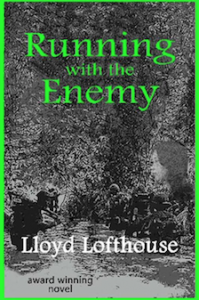
Yes, I despise both of the villains in my latest novel, Running with the Enemy. One sexually abuses his sister and treats her as if she was his personal slave and deserves to be abused because she was born after their mother ran away from home to live with a lover. The other villain enjoys torturing and killing his victims. His favorite weapon is his teeth that he files until they are razor sharp so he can easily disfigure his victims and bite off body parts.

RunningWith

Can you tell us about your road to publication?

My road to publication started in 1968 when I took a creative writing workshop my first year of college where I wrote my first novel. Without an agent, I mailed out hundreds of queries to publishers and one publisher was interested.

To make a long story shorter, that small publisher was interested in pushing one book by a new author but was looking at two authors. The editorial board split between my work and the other author.  There was no clear majority, so the publisher hired a consultant to decide and he picked the other guy.

I kept writing and eventually earned an MFA in writing. I then attended the UCLA writing extension program for several years.

After five years and a finished and very polished manuscript, the UCLA professor found me an agent who represented the book I wrote in that program to publishers. The feedback—Random House was one of the interested publishers. In the end the feedback was the same from all of the publishers.  We enjoyed the book but the market’s glutted with Vietnam War stories. No one was interested.

I kept writing and the books I wrote kept getting rejected.

Then the publishing world changed drastically because of Amazon, POD and e-books. I discovered that authors didn’t need agents or publishers and could self-publish my work and sell through Amazon.

I stopped banging my bloody head against the great wall of traditional publishing and came out with my first novel in December 2007 that landed in a local Barnes & Noble brick and mortar bookstore for a few weeks in addition to landing on shelves in a few independent bookstores near where I live. My Splendid Concubine has now earned more than a dozen literary awards and sold more than 16,000 copies. Concubine was not my first book or the one I wrote at UCLA. Over the decades, I’ve written more than a dozen manuscripts.

Were you “born to write” or did you discover your passion for writing later in life?

I don’t think I was born to write. I was motivated to write. I can pinpoint the time. It was 1968 soon after I was honorably discharged from the U.S. Marines and started to attend a community college on the G.I. Bill. For one of my electives, I signed up for a creative writing class.  Then I attended a lecture at the college given by Ray Bradbury. What Bradbury said flipped a switch inside my brain and that’s when I decided I wanted to write books.

If you were to write a non-fiction book, what might it be about?

It would be a memoir called Crazy is Normal, a classroom expos”, and I’m working on the second draft of that memoir now.

Have you ever started out to write one book and ended up with something completely different?

Yes, my latest novel, Running with the Enemy, was as a complete memoir that I wrote at one university and then it morphed into a suspense thriller when I attended the writer’s extension program out of UCLA.

We all know the old saying; you can’t judge a book by its cover. This is true. However, how much importance do you place on your book cover design?

A book cover is the first thing a reader sees so I place a high value on book covers. For instance, the Midwest Book Review checks the covers of books submitted to them for a review first and if a cover does not look professional, that book does not get reviewed.

Do you write anything besides novels? Care to share?

Yes, I have several Blogs that I write for and host: There’s Anything Goes at Lloyd Lofthouse.org; iLookChina.net; Crazy Normal, an insider’s look at education, teaching, parenting and coming of age, and The Soulful Veteran with war, combat and the troops as the primary theme.

(See blog links at bottom of page)

What makes you angry?

When I read about the public schools and teachers being criticizes as if they are all failures and have to be replaced by corporate-run private sector schools. I also get angry when anonymous cyber bullies target an author and spread lies about them and their work to deliberately destroy an author’s career.

What’s your favorite film of all times? Favorite book?

The Hobbit and The Lord of the Rings for both answers.

What’s your favorite comfort food? Least favorite food?

Apple pie is both my favorite comfort food and one of my least favorite foods because it’s made with sugar and white flour for the crust. I’m into health and sugar and white flour don’t make the list when it comes to healthy eating.

If you are a TV watcher, would you share the names of your favorite shows with us?

I don’t watch TV. I don’t like TV because of the commercial breaks. Therefore, I watch DVDs that started out as TV programs. My favorite TV show that graduated to DVD is Elementary with Jonny Lee Miller and Lucy Liu [I’m keeping an eye on the DVD release date for the second season] and then the Game of Thrones ranks second—season three will be out on DVD February 18, 2014.

It seems that I’ve also been captured by AMC’s The Walking Dead, and I’m in the middle of watching season three.

While I wait for the next DVD release of my favorite TV shows that graduated to DVD, I keep trying out new ones to see which will make my to follow list.

CONNECT WITH LLOYD

Website

Twitter

My Splendid Concubine

Running With The Enemy

Anything Goes Blog

ilookChina

Crazy Normal: The Classroom Exposé


CHAT WITH LUCIANA CAVALLARO

LucianaCLuciana Cavallaro taught in government and private schools and during this time studied Ancient History, attended writer’s workshops and concluded a course in proof reading and editing. She has travelled extensively and has revisited her favourite destinations—Greece and Italy— the inspiration for her stories. After working in high schools for many years she resigned to concentrate on writing.

Time to chat with Luciana!

I hear you have some very exciting news! Can you share it with us?

Yes! I have recently launched my book Accursed Women, a short story collection about five women from Ancient Greek mythology. The characters in the book have been vilified throughout history and I wanted to tell their side of the story. Were they as terrible as the legends say they were or were they a victim of circumstance?

LucianaBook

What do you think some of the greatest misconceptions about indie authors are?

I believe people/readers think the quality and standard of books written by indie authors aren’t very good. It’s a matter of finding a diamond in the midst of the rubble. It is a stigma I feel will be around for a while till the playing field between indie authors and ‘traditional’ authors is even. Having said that, the industry of indie publishing has grown and we have access to excellent services to produce worthy books that rival the big publishing companies.

Is it important for you to know the ending of a book before you write it? The title?

Not really, I tend to let the flow of the story determine the ending. I don’t like to plan too much of the story, just outlines with key plot points. I find it allows me greater freedom to be more creative and allow the story to develop of its own accord.

I do like to have the title of the books in mind first. It helps steer the theme of the story. Much like my book Accursed Women, the title came to me after I had written the first story in the collection.

After working for a very long time on a novel, many authors get to a point where they lose their objectivity and feel unable to judge their own work. Has this ever happened to you? If so, what have you done about it?

Oh yes! Writers are generally perfectionists and I found it difficult to admit the story I was writing wasn’t working. I did believe it was good but when I started to submit the story to agents it was rejected. So I shelved the idea and stop submitting. I began writing the short stories instead, needed a fresh start with a completely different concept. It was the best decision I made. I had just finished the final short story when I had a ‘light-bulb’ moment. I pulled out my manuscript and now am rewriting the story.

How important is the choosing of character names to you? Have you ever decided on a name and then changed it because it wasn’t right for the character?

Choosing characters names is perhaps like choosing a name for your child, you got to live with it as they do. Names give a character a persona and like us all we grow into it and establish who we are.

I went to a writers’ workshop where the names of the characters I had given were critiqued. They found the names confusing as they were too famous and would confuse readers. I don’t personally believe that as readers are discerning and smart but as the workshop was led a famous fantasy author, I changed the names. It was hard as I got know the characters very well, lived and breathed their world. The new names work well and now the story has changed, it fits even better.

Can you tell us about your road to publication?

I did try the traditional route for a few years though the submissions were ad hoc until a few years back where I decided to be more persistent. That led nowhere and friends suggested self-publishing and eBooks. I wasn’t entirely convinced this was the best path for me, I mentioned earlier about the stigma attached to indie authors, and did resist the idea. Thought I dip my toes with short stories and well, I haven’t looked back since. I am so happy with my decision to follow the indie path and join the other great indie writers on this amazing journey into publishing and literature.

How much research was involved in writing your book? How did you go about it?

Research is an integral part of my stories, without it the book would not work. I wanted to propel readers into the past, make them feel as if they are there and a part of the story. It was important to me I got the descriptions of the clothing and time period as accurate as possible, but with a little creative licence 😀

For Accursed Women, I researched and read mythologies on each of the characters in the story. I wanted to get to know them, where they came from and how they lived, and made notes. With regards to the trilogy I’m writing, it is based on the Atlantis myth and set around 500 BCE. I have collated files on the various places and cultures of the time as well as names plus the books I have in my collection to help create a story readers’ can relate to.

We all know the old saying; you can’t judge a book by its cover. This is true. However, how much importance do you place on your book cover design?

I believe a good polished book cover is very important. I know when I go into a bookstore the first thing that grabs my attention is the cover. I used to tell my students don’t judge a book by its cover but we are visual beings and what draws one’s attention is an attractive cover. Of course the cover is only as good as the content. The story must be polished so it sparkles.

Do you have complete control over your characters or do they ever control you?

No control over my characters whatsoever! They dictate the terms. When they play nice, the story flows when they dig their heels in, forget it!

Do you miss spending time with your characters when you finish writing them?

I don’t miss them really, they are always with me, chatting away or silently brooding. In fact, they’re like the bad house guests who don’t know when it’s time to leave.

Have you ever walked out of a movie? If so, what was it?

Came very close with two movies: 300, which I laughed all the way through and Limitless—that was a terrible movie!

What’s the best gift you’ve ever received?

A surprise birthday visit from my sister, brother-in-law and my nephew and niece. I wasn’t expecting anyone and the whole family turned up.

Where do you live now? If you had to move to another city/state/country, where might that be?

Perth, Western Australia. Hmm… a hard question as I think this is best place to live, not biased or anything ;D, but I’d like to live on one of the islands in Greece. Would be very inspirational too.

Thank you Lisette for having me on your Writers’ Chateau.

My extreme pleasure, Luciana! I really enjoyed getting to know you.

CONNECT WITH LUCIANA

Website

Goodreads

Facebook

Google+

Twitter

Email: cluciana@y7mail.com

CHAT WITH RACHEL THOMPSON


Rachel Thompson is the author of the award-winning Broken Pieces, as well as two additional humor books, A Walk In The Snark and Mancode: Exposed. She also owns BadRedhead Media, creating effective social media and book marketing campaigns for authors. Her articles appear regularly in the San Francisco Book Review (BadRedhead Says…), 12Most.com, bitrebels.com, BookPromotion.com, and Self Publishing Monthly. She hates walks in the rain, running out of coffee, and coconut. She lives in California with her family. 

Time to chat with Rachel!

What is your latest book?

I released my third book, Broken Pieces, last December. It’s a departure from my earlier humor books (Mancode: Exposed and A Walk In The Snark) but I felt it was important to address some of the difficult experiences I’ve had and what I’ve learned from them.

It’s done better than I ever dreamed – seven awards, 5-star reviews from top Amazon reviewers, but more importantly, the incredible bond I’ve formed with other survivors of childhood sexual abuse.


I hear you have some very exciting news! Can you share it with us?

Booktrope signed me for the print version of Broken Pieces this past fall, and the print version was published at the end of 2013.

Is your recent book part of a series?

You know, it didn’t really start out that way, but of course, I had so much more to say! I’ve also received feedback from readers that they want more, so I’ve started writing the next book, Broken Places, due next year.

What are the special challenges in writing a series?

Well, this is interesting because it’s narrative nonfiction, written in essays, poetry, and prose. So it’s different in structure from telling a more traditional story with archetypes and arcs – but ultimately, it’s a story I’m telling, so some of that applies.

If you were to advertise your book on a bumper sticker, what would it say?

Broken Pieces inspires survivors of childhood sexual abuse and lost love.

What else have you written?

My two humor books mentioned above (all books available on Amazon), two blogs, multiple guest articles (12Most.com, bitrebeles.com, weekly for BookPromotion.com, monthly for the San Francisco Book Review, and Business 2 Community, and the new Self-Publisher’s Monthly), and a local Examiner (way back when).


What do you think some of the greatest misconceptions about indie authors are?

I read and reacted to an article this past fall – something along the lines that ‘all indie books are crap’ and the guy (it’s always a guy LOL) said we’re ruining literature and that we don’t know anything beyond ‘Buy my book!’ tweets.

Without going into great detail, let’s just say I disagreed and provided concrete proof that many indie authors are award-winning, well-reviewed, produce professional books, and are being signed. Those types of generalities drives me nuts.

That said, I have read some horrible indie books. Like anything, the onus is on us, the author, to work with professionals (editors, formatters, proofreaders, graphic designers) to make our book as amazing as it can possibly be.

What part of writing a book do you enjoy the most? The least?

I tend to become sort of obsessed with a comment or word and the pre-writing starts in my head. When I sit down to actually write something, I have that as my guiding theme or watchword, if you will. It goes from there.

I tend to outline in a general way, in that I’ll have major themes (like love, loss, grief, etc) and I write with those in mind. As a nonfiction author, I tend to not like chronological order but that’s a personal choice.


Some authors, like me, always write scenes in order. But I know some people write scenes out of order. How about you?

As a nonfiction writer, scenes are different because I’m writing on a particular topic.

Is it important for you to know the ending of a book before you write it? The title?

I definitely want to know the title. That’s always the main theme for any work, in my opinion. As for the ending, I definitely have the beginning, middle, and ending in mind as a guideline. Because my work is more free-form, I don’t have to adhere as closely to fiction guidelines.

Some writers edit excessively as they write; others wait until a novel is finished to do the bulk of the editing. How about you?

I wait.

I don’t self-edit as I write, though I will go back over a piece before I send it on to my editor.

After working for a very long time on a book, many authors get to a point where they lose their objectivity and feel unable to judge their own work. Has this ever happened to you? If so, what have you done about it?

Yes, absolutely. I tell my editor that I’m “saturated,” and can’t even look at it anymore. That’s why having an editor you can work with and trust implicitly makes such a huge difference for authors.

Have you ever written characters that you truly despise?

In Broken Pieces, I wrote about being molested by my next-door neighbor (I was eleven; he was an adult with five kids). That wasn’t easy but I also didn’t write from his POV. I’m not sure I could do that, emotionally.

Do you have any advice for first-time authors?

Some tough love:

Stop making excuses. Stop worrying about what others will think. People will hate it – get over it. If you’re worried about sharing sex scene because your parents/kids will know, guess what? They already know – the jig is up.

Give yourself permission.

Can you tell us about your road to publication?

I have self-published all three of my books. I’ve been approached by a few agents (who found me on Twitter, actually) but it didn’t work out. And that’s okay – I enjoy my 70% profit/book!

I did recently sign with Booktrope for print. They vet all books through their submissions process, but once you’re in, you’re in. I look forward to working with them on future books also. They are a hybrid publisher, so I retain more profits than if I went traditional. And I’ll still self-publish. I’m all in.

Please, tell us about your experiences with social media. What are your favorite and least-favorite parts of it?

I’ve loved Twitter since day one. It’s short and sweet, the conversations are great, and it’s a wonderful equalizer: I’ve spoken with many authors, musicians, and even a few tech people – household names – who couldn’t have been nicer.

Do you have any grammatical pet peeves to share?

Too many! But my main one is that alot is NOT a word, people. It’s a lot. I feel bad for our teachers at this point. I mean, really?

I used to be exclamation mark averse, but I’ve started using them in a judicious manner. Maybe I’m just not that excited about things as other people.

What do you like best about the books you read? What do you like least?

I adore involving characters with rich inner lives. I’m not big into genre fiction – I’m more a poetry and literary fiction kind of girl. That said, I’m a sucker for an engaging time-travel story.

How much research was involved in writing your book? How did you go about it?

I’m thankful to have kept many journals over the years – many of them half started with pages ripped – but it was extremely helpful to read about my twenty-year old self and all the impressions and angst while writing all of my books.

I’m also the Google queen. I look up EVERYTHING. If you want to know something, it’s out there.

Do you allow others to read your work in progress, or do you keep it a secret until you’ve finished your first draft? Can you elaborate?

I definitely feel we have to share our work. Writing in a bubble gives an author zero objectivity. So I share pieces here and there with my editor (knowing she’ll see it all when it’s done, of course), as well as a few writer friends whose opinions I respect. I also share on my blog – it’s good for people to stay in touch and see what we’re working on.

I also feel strongly that betareaders are an integral part of my process. They are readers! Of course I want their opinion.

Have you received reactions/feedback to your work that has surprised you? In what way?

My first two humor books are satirical, yet many readers take the work literally and become offended. At first, I was upset that people would think I was a bad person. Then, after getting 1-star reviews saying I’m a terrible mother (because I let my kids listen to Queen), or headed for divorce (because I talked with an ex), I’ve gotten used to it.

I’ve learned not to take anything personally with regard to reviews. The reviews that really touch me are the ones from other childhood sexual abuse survivors – I’ve even created a private Facebook group because that bond is such a connector for so many. Being the voice for people has been extremely gratifying.

Do you write anything besides non-fiction?

I am currently working on a romance.

Were you “born to write” or did you discover your passion for writing later in life?

I started writing at age 10, after my teacher read us The Secret Garden. I was mesmerized, and decided I wanted to write like that someday!

Do you dread writing a synopsis for your book as much as most writers do? Do you think writing a synopsis is inherently evil? Why?

Not really. People need to know pretty quickly whether a book is right for them. If we can’t explain it in a few sentences, how will they get it?

If you were to write a novel, what might it be about?

Similar topics that I write as nonfiction: relationships, love, loss, grief, family.

Do you have any advice to a new author if they asked you whether to pursue the traditional route to publishing or to start out as an independent writer?

I say explore the middle – look at hybrids like Booktrope. It’s an excellent option.

What have you done to market your books and what did you find the most effective? The least effective?

I do everything! The best thing an author can do is connect with readers on a personal level, and blogs and social media allow for that (notice I said ‘connect’ and not blast with constant ‘Buy my book!’ links). Advertising is also very helpful: I make my husband do my Google Adwords (too much like math for me), and now he’s started a business and does Adwords for scores of authors!

I say try everything: do promotions, price reductions, giveaways, blog tours, blogging, guest blogging, interviews, social media, ads – it all increases your Google ranking and therefore, your visibility.

I’m sure you’ve read many interviews with your fellow authors. In what ways do you find your methods of creating most similar and dissimilar?

I tend not to dissect the writing process as intensively as many others do (not that I have a problem with that, of course). I find there’s just something magical about creating something from nothing – a gift if you will – and I love when the words flow through me and form sentences that carry that magic.

A less woo-woo answer is: do whatever feels right for you. There’s no right or wrong. Yes, writing is an art and a craft. There are ‘rules,’ which I personally feel are meant to be broken. Play with it, have fun with it. Make it your own.

Do you feel your latest book is your personal favorite or one of your previous books?

Yes, absolutely. Broken Pieces is personal, and it discusses difficult topics most people shy away from. It’s not for everyone and that’s okay, too. It’s a win for me either way.

Having our work out there to be judged by strangers is often daunting for writers. Do you have any tips on handling a negative review?

It’s hard. I get it. I DO. But look at what they’re writing and see if there’s at least one nugget of helpful information. We are so inside our heads all the time, and nobody can live our memories or experiences. Writing is the next best thing.

Listen, nobody universally likes any one book.

Many authors do giveaways; have you found them a successful way to promote your book?

I have found success going free on Amazon (my eBook), but I find that one or two days is plenty as long as you get the word out via the various ‘free sites’ that list our books.

Have you been involved with the Kindle Direct Program? If yes, do you believe it’s worthwhile?

Yes, I have and Yes, I do. All three of my books have gone free and then ranked much higher than if I hadn’t taken them free. That said, two times/year is plenty. Our books are worth something – we worked hard and invested a lot of time and money in creating them. Don’t sell yourself short.

Are you an early bird writer or night owl? And do you have any must haves like coffee, chocolates, wine, music or something else?

Definite night owl. I HATE getting up early. I’m allergic to it. I go straight to my coffeemaker every morning, first thing, don’t talk to me, don’t look at me, just don’t. And music, absolutely.

We all know the old saying; you can’t judge a book by its cover. This is true. However, how much importance do you place on your book cover design

It’s HUGELY important. People absolutely do judge a book by its cover, especially since we purchase 50% of our books online now.

Every day brings forth new changes and shifts in the world of publishing. Any predictions about the future?

I think hybrid publishing will become bigger than ever as authors (both indie and traditional) look for a middle ground.

Do you have complete control over your characters or do they ever control you?

I think it’s a combination of both, for me. I have character portraits I outline but once the story start to go, it starts to go.

How would you define your style of writing?

Free-form, to a certain extent. It’s always important to me that I avoid cliché at all costs – sometimes I’ll take one and completely deconstruct it as to make it unrecognizable. That’s a fun challenge for me.

A lot of authors are frustrated by readers who don’t understand how important reviews are? What would you say to a reader who doesn’t think his or her review matters?

I go back and forth on this. I’m an avid reader and I certainly understand that the book I’m reading means so much to that author. If it’s not up to par, I would never leave a poor review; rather, I contact the author with my observations.

It’s something we have to learn, as authors, that not everyone will like our work and that’s okay. Learn what you can from the negative reviews and then just move on. Keep writing. Always.

Do you ever suffer from writer’s block? If so, how do you get around it?

I haven’t – perhaps it’s because I write so many articles and blog posts, I always have ideas for my writing.

What genre have you never written in that you’d like to try?

I’d definitely be interested in writing time-travel or something paranormal – not vampires or wolves, but a different type of world.

Have you ever started out to write one book and ended up with something completely different?

Yes! I started to write the third of my humor books (Chickspeak: Uncovered) and just didn’t have my heart in it. Broken Pieces was pushing its way out. I just had to open the door.

What do you know now that you wish you’d known five years ago?

To trust my voice.

Everyone has an opinion about our writing, but ultimately, it’s our name that goes on that book. You.

Would you like to write a short poem for us?

‘Happiness leaves no scars.

Pain leaves evidence.

We know where we’ve been.’

~ Broken Places (WIP)

Where do you live now? If you had to move to another city/state/country, where might that be?

I live in Northern California, even though I’m still RacheintheOC everywhere. I lived in Orange County, CA for 17 years. I grew up here so it’s great to be back. If I could live anywhere, I’d live in Europe – I love the history and architecture. London, most likely.

Trains, planes, automobiles, or boats?

I enjoy trains and planes – the whole adventure of it. Cars are okay – traffic sucks. Boats – I’ve never cruised so I can’t say, but I’d like to one day.

What’s your favorite comfort food? Least favorite food?

Favorite: Everyone knows I love Nutella, though I don’t even keep it in the house anymore. I have absolutely no willpower when it comes to that stuff. Least favorite: Lima beans ties with green peppers. Blecch.

If you could have one skill that you don’t currently have, what would it be?

To draw, be an artist. I draw stick people and even then, they’re pretty awful. And to cook – I burn everything.

What makes you angry?

Racism and abuse.

What music soothes your soul?

I listen mostly to female singers. I love love love Tori Amos, Poe, and Imogen Heap. New favorites are Lana Del Rey and Banks.

What was the most valuable class you ever took in school? Why?

Journalism and Communications studies in college. I use much of what I learned then in every day life.

If you are a TV watcher, would you share the names of your favorite shows with us?

Friends, Doctor Who, Weeds, Castle. I don’t watch a lot of TV (I have a husband and two kids who fight for it) but when I do, I turn those shows on.

If you could add a room onto your current home, what would you put in it?

I’d love a studio – my daughter (age 14) is an amazing artist. I’d love her to have a space set up just for that.

What’s your favorite film of all times? Favorite book?

Film: Blade Runner, hands down. Book: The Time-Traveler’s Wife (the movie sucked though).

Have you ever walked out of a movie? If so, what was it?

I almost walked out of Lord of the Rings – not a fan (ducks). But I stayed and shut my eyes. I’m not big into violence.

Do you have any guilty pleasures?

Mani/pedis. I rarely take time for myself, but this is a gift I give me once every few months.

What are three things you think we can all do to make the world a better place?

Have more compassion, be less judgmental, give more than we receive.

What simple pleasure makes you smile?

Watching my children sleep.


CONNECT WITH RACHEL

Author website

BadRedhead Media

Facebook

Facebook Broken Pieces Fan Page

Twitter

BadRedhead Twitter

LinkedIn

Goodreads

Author Newsletter

BadRedhead Media Newsletter

Broken Pieces (paperback)

Amazon Author page

Email: RachelintheOC(at)gmail.com


4 Tips to Writing a Better Novel


by Lisette Brodey

Tip #1

KEEP A TIME CHART: Even if you never mention particular dates in your novels, it’s important that you know the day and date of every scene. You may ask, “Why do I need to know that if it’s not part of my novel?” I’ll tell you why.

When you’re in the thick of writing your book, it’s very easy to lose track of how much time has elapsed between events. In some of my novels, my characters have had such long, complicated days that it’s taken me chapters to describe the action. Conversely, I may skip ahead two weeks, a month, or even years. It all depends on the story.

Every time I begin a novel, I pull out a calendar, and I choose a date. Sometimes it has everything to do with the story and what time of year it is, sometimes it doesn’t, but it’s still important. Let’s say your character is an unhappy wife who is keeping tabs on her husband’s whereabouts because she is convinced he’s cheating. In Chapter 7, she’s having lunch with her best friend and telling her everything that she has just found out. Can you accurately have your character tell her friend what happened five days ago, what happened three days ago, and what happened two weeks ago if you don’t have it noted? I sure can’t.

If you keep a dated time chart with a simple synopsis of what happens when, it will save you lots of headaches down the road.

07-april1

Tip #2

KEEP IT TIGHT: Let’s stay with our story of the woman who thinks her husband is cheating on her. There’s a twist in this story. She finds out that he’s not cheating at all but wants her to think he is because he’s being blackmailed and is actually trying to protect her by letting her assume the lesser of two evils. Ah, the plot is thickening. Let’s say that in Chapter 10, the woman makes a major discovery that changes her perspective on what is going on. Before you create a brand-new character to deliver that information to her, make sure there are no existing characters that can do the job. Don’t introduce your reader to new people if they serve no real purpose and will do nothing more than clutter or dilute your prose. When you use established characters, you may just come up with even better plot twists than you imagined. You may very well need a new character, but take the time to think about it. Keep it tight.

Tip #3

LISTEN TO YOUR NOVEL: Most of us know that it’s very difficult to proof your own work. Your eyes tend to see what is supposed to be there, not what is there. If you have spent an hour reworking a paragraph or speech, you may have become so immersed in getting it right that when you read it back, you don’t notice that you’ve used a particular word three times in two sentences. Unless it’s intentional, it’s not good. Most computers have text-to-speech functions. To review your work, highlight the part you want to hear, place it in a new document, and highlight it again. Then, sit back and listen to your words. If there are words missing, misspelled, or repeated, you will hear them. Listening gives you a different perspective than reading.

You may wonder why I suggested putting your text into a new document. You ask, “Why can’t I just highlight it in the document I’m using?” You can, but as you know, highlighted text can disappear instantly if a wrong button is touched on your keyboard and you can’t quickly hit Control Z (PCs) or Command Z (Macs) to undo. That’s all. It’s just a safety measure to protect what you’ve written.

WomanComputerTipsBlog

Tip #4

USE YOUR FIND COMMAND: Do you have pet words or phrases that you tend to overuse? I know that’s always a worry for me. When I’m immersed in telling a story, my brain is focused on the action and sometimes I’m merely serving as a transcriptionist for my characters. Sometimes my editor will catch these repetitions and just as often, I’ll catch them myself. If you’re able to identify words or phrases you might overuse, use the FIND command in Word (or other software). Then, change them or rewrite sentences to avoid them. Just get ’em outta there. And remember, the more unusual the word, the more obvious the repetition.

What are your favorite writing tips?


CHAT WITH ACE ANTONIO HALL

AceAntonioHallAce Antonio Hall graduated from Long Island University with a BFA. He is a former NYC middle school English teacher who can’t get enough of zombies and Spider-Man comic books. When he’s not in the gym working off the extra calories from eating way too many donuts, Ace writes young adult horror fiction. His YA zombie novel, Confessions of Sylva Slasher was released by Montag Press on April 14, 2013. 

Time to chat with Ace!

I hear you have some very exciting news! Can you share it with us?

Yes! I was so honored to have taught an intensive 3-day writing workshop at the Los Angeles Science Fiction Convention (LOSCON 40) at the LAX Marriott at the end of last month, November. Each day was three-hours, and marked the first time I worked in the capacity as a teacher since 2006, when I was an Associate Director of Education at the Sylvan Learning Center in Northridge. I hope it was the best LOSCON had ever seen and they will ask me back for 2014. Fingers crossed.

Is your recent book part of a series?

Well, Lisette, I’m so glad you asked me that question. As a matter of fact, yes! My publisher came up with the moniker/sub-genre ZOMBIE POP, really by mistake, to describe to the new illustrator how the artwork should ‘pop’ off the cover for the second edition, and Emilio, who did an incredible job capturing the essence of how I envisioned Sylva Slasher, latched onto the name and used it on the cover.

It opened my imagination to tap into the cultural world of the youth for my young adult series. My first novel, which was recently released, Confessions of Sylva Slasher is Zombie Pop, Volume 1, and the next book, which I’m half-way done with, Sk8board Xombies, or Skateboard Xombies, will be the next in a four-part Sylva Slasher series.

Being that Sylva rides BMX bikes and skateboards, the second book is going to be one heck of a roller coaster ride with plenty of twists, turns and cliff-hangers—even more than Confessions.

Screen Shot 2015-09-06 at 9.21.46 PM

If you were to advertise your book on a bumper sticker, what would it say?

Got Zombies? Sylva Slasher does. Teen for Hire or Zombies Love A Girl With Brains! My publisher is working on tee shirts to market, right now, as you read this.

What part of writing a novel do you enjoy the most? The least?

I can say that I love character building, world building and creating visual scenes the most. I get a real kick out of seeing all of that come together when the characters walk out of the page and speak to me in vivid language and imagery. Add Christmas, Halloween, German Chocolate cake and falling in love together in one big bowl of excitement and that would pretty much summarize how I feel developing those aspects of my story!

The least? Editing sucks. I spent fifteen hours straight reading my entire novel and cleaning up edits to turn the manuscript into the publisher to meet the deadline. My butt and back were mad at me for weeks after that … but I’d do it all again, because it was part of my dream becoming reality, and the end result of my feelings from seeing my book published can’t even be put into words. If I did it would sound something like, “Yesssyesssyesssahhomigodexpialidociousbooyahzzzzzmmtt eyemmsoolovingituh!”

… See? Can’t be put into words.

How much research was involved in writing your book? How did you go about it?

Tons. The funny thing about research is that I can have two pages of research that will show up in only one or maybe two sentences of the novel. I love to use experts and specialists as consultants to make sure that I’m providing sound logic and intelligent continuity. It’s important to me that, even though it may be fiction, it has a basis for reality.

Some authors, like me, always write scenes in order. But I know some people write scenes out of order. How about you?

For the most part, I write them in order. I will usually lay out some kind of skeleton, or structure from beginning-to-end of the story, and then change it, as my imagination flows freely. Alexandra Sokoloff and Christopher Vogler’s ideologies have been the backbone of my structural processes.

Is it important for you to know the ending of a book before you write it? The title?

Yes, because I come up with so many ideas, I’m all over the place. Knowing the ending of the book keeps me focused, and the title, which usually changes by the time I’m halfway finished with the book, or have gone through a few rewrites gives me direction.

How would you define your style of writing?

Fun, fast-paced and spine-tingling. I am a very visual person, so I try to bring my set pieces to life so that no matter what age-level of the reader, they can see what I paint on the page. Since I am obsessed with the Twilight Zone (one year, on my birthday, which is July 4th, I stayed in bed and watched fifteen hours of a TZ marathon), I love speculative fiction, as well as psychological thriller and infused elements of each into my stories.

How important is the choosing of character names to you? Have you ever decided on a name and then changed it because it wasn’t right for the character?

I am obsessed with words—love to write, read and recite them over and over. I believe they have such great power! Names, to me, are just as powerful! They dictate invisible energy that can be received and processed in so many ways. Many cultures believe names to have spiritual significance, and I share that same thought process. If you look at how powerful pseudonyms, stage or pen names are, you will begin to see how important they can influence success. Have you ever noticed how many very successful celebrities have names that are so uncommon or unique that if anyone else decides to use that same name, they seem unoriginal, at best?

I go to great lengths to find names that bind the character spiritually, mentally and physically to create a persona that is unique to their experiences in my novels. For example, Sylva’s first name is because simply, her mother fell in love with her gray, or silver eyes at birth. Her last name, Fleischer, means butcher, which of course is synonymous with Slasher. Being that I’m a huge comic book fan, Sylva Slasher rolled off the tongue as easily as Silver Surfer. It just felt right, and I went with it.

I think my favorite character names are Luke Skywalker, Hannibal Lecter and Cruella de Vil. Magnificent names. Don’t you think?

(Yes, I do! Fantastic, legendary names!)

Would you like to write a short poem for us?

Aw, Lisette, I would absolutely love to:


One day the moonlight said to me

To make my mark before I leave …

Was more her faith in me to be.


She said be a significance

In someone’s life beyond my kids;

I have been doing ever since.


For life gives us a choice to make

To play the rules and some to break …

The daring brave do choose their fate.


I choose to think out of a box

And sometimes do what some will not …

And some place go where some cannot.


Better to be significant

Than leave a stench of a vial scent

And face an end of poor time spent.


For there are those who leave a mark

Only to die without a heart

And left on stage without a part.


Better to leave a mark today

And touch a life in special way

Through pen, and voice, and character, create.


Let’s call that poem … let’s see … um, I think … THE WRITER’S CREE … yeah, that’s it!

Where do you live now? If you had to move to another city/state/country, where might that be?

I live in South Pasadena, but would love to live part of the year in Hawaii, and the other part in Venice, Italy!

If you could be invisible for a day, what would you do?

I would spend the mornings watching Stephen King’s process and absorb as much as I possibly could whenever he spoke to Tabitha, or anyone he communicated with. I’d follow Jackie Chan around, hoping to catch him working out, or practicing, and video tape every single one of his moves so I could translate it into Sylva’s martial arts technique. And lastly, I’d spend the evening skinny-dipping in the island waters of Hawaii, floating, chillaxing and watching the moon, breathing in the air of imagination and fantasy.

If you could duplicate the knowledge from any single person’s head and have it magically put into your own brain, whose knowledge would you like to have? And why.

Stephen Spielberg. He understands how to capture magic, fill our hearts with wonder, and drive the world into fascination. I’d love to be able to master that.

Have you ever walked out of a movie? If so, what was it?

The South Park movie. Wasn’t my cup of tea.

Do you have any guilty pleasures?

Indeed! Donuts. I love donuts. Especially, the big fluffy ones sold in Mom & Pop stores in Los Angeles. My Nana used to make them from scratch when I grew up in Jacksonville, Florida, and there wasn’t anything that could match the taste of those donuts, hot off the stove … except the donuts in Cali. I’ve had them all up and down the east coast, but will work out six days a week, and run six miles a day, just so I can eat as many Los Angeles pink-boxed baker’s dozen donuts as I can eat without the added tires to my waistline.

What are three things you think we can all do to make the world a better place?

Ride flying skateboards, vote for a lifetime supply of free beer for all Dallas Cowboys fans, and lobby at Marvel Studios for Stan Lee and the studio executives to contract Sylva Slasher to become an animated/anime series, comic book line, and hit television series featuring Buffy the Vampire Slayer as a mentor and guest star. Okay, so I’m a big dreamer. Never, ever quit, and always dream big!


CONNECT WITH ACE

IMDb Actor Page

Amazon Author Page

Author Website

Twitter

Author Blog

Full Bio Webpage

CHAT WITH A.T. RUSSELL

AT_RussellA.T. Russell is a retired Navy Chief currently residing near Chicago with his wife of 25 years. A lifelong reader, the passion of writing came to him midlife. A.T. writes Urban Fantasy and aspires to write across many genres.

“History is a point of reference, not an anchor.” ~A.T.

 Time to chat with A.T.!

What is your latest book?

My latest book is Apex. As for writing and the other stories I’ve written, this one is probably the most challenging, and for me that makes this one the most exciting to write.


Is your recent book part of a series?

It is. In fact, Apex is the first of four planned books. I’m actually franchising the series, and I’m very excited to report that Dawn Kirby and Frantiska Oliver will be writing two of the volumes. The last position will be decided by a process that Twisted Core Press is designing and I think it’ll be a trendsetting model for years to come.

What else have you written?

 As some may know, I’m a member of 7DS Books, a short story platform and imprint of Twisted Core Press. I’ve had the great opportunity to write Greed for Seven Deadly Sins, Sleepy for Seven Dwarf Stories, Eddie’s Ring for Seven Dress Sizes, and No Man for A Man’s Promise. Above all, however, my greatest pleasure came from writing my first two books, New Alpha Rising: Ascension Parts I & II


How often do your characters surprise you by doing or saying something totally unexpected?

You know, I have one character that has been the most thrilling challenge I’ve faced in storytelling. Little Wolf says what she wants when she wants to, and no one can stop her, not even me. Thing is, she’s the only character I’ve written that has had that effect on me, and writing around her, even in scenes I didn’t want her to be a part of, is where the challenge lies. She’s a main character in New Alpha Rising Saga and I look forward to sharing her madness with the world in the third book.

How important is the choosing of character names to you? Have you ever decided on a name and then changed it because it wasn’t right for the character?

I believe choosing a character’s name is critical to any story. From my perspective, names should be memorable, respective of the character’s personality, and above all, brand-able.

Were you “born to write” or did you discover your passion for writing later in life?

This is a great question for me, because the answer is, I have no idea. All I know is that I have to write. The passion came along in 1994 and words began to hit the page in 2009, totaling over three million that year. Ever since, I’ve been head down and punching keys.

Having our work out there to be judged by strangers is often daunting for writers. Do you have any tips on handling a negative review?

My best advice to handling a negative review is simply remembering that your imagination belongs to you. When you share it with others, their imaginations may not be a good match. If and when that is the case, remember that stories written by the historical greats were ripped worse than yours, and that was by people who really mattered in the literary industry. Nowadays everybody is a critic, and tearing others down is a sad truth about our overall culture today. After all, isn’t that what reality tv is all about? Judge this and judge that, then let’s see who can rip the hardest. Seems like a lot of people channel Simon Cowell these days.

Every day brings forth new changes and shifts in the world of publishing. Any predictions about the future?

I think Amazon will become the BIG ONE.

Have you ever wished that you could bring a character to life? If so, which one and why?

I would love to bring Little Wolf to life. She’s a doctor, a killer, and an Omega Wolf. She loves hanging out with puppies and watching cartoons, and world peace would piss her off. Other than those things, she’s about as cool as any creature I can, did actually, imagine. If I could wish, though, the whole world would know Little Wolf as well as I do.

What genre have you never written in that you’d like to try?

I typically have a romantic element in every story I write, but I really want to tackle a full-on romance. Trouble is, every time I write, the theme of the story pervades many aspects of my daily life. With my luck, pouring my passion into romance, my wife of 25 years might think I’m flipping the script on the second half of my life and have me committed or something … or worse.

Please, tell us about your experiences with social media. What are your favorite and least-favorite parts of it?

Social media is a wide open expanse, a tremendous pool of laughs and thoughts, though sometimes myopic and quite scary. You see, some authors use their platforms for their family members and personal friends to interact with them. That’s cool, but when their profile is supportive of their books, services, etc… they shouldn’t complain when a fan or interested customer comes along and steps across a line they’ve blurred. I’ve seen a number of people trip over that line and get burned in the process. No, it hasn’t happened to me.

What might we be surprised to know about you?

I’m very humble and I don’t say much on social media platforms. I think, maybe it’s shyness on my part. Heck, it could be fear of the unknown. I mean, I am shading 50, so it’s possible I have old school hesitancy. I’m getting better at interacting with others, though.

What’s your favorite film of all times? Favorite book?

My favorite film is Something The Lord Made. The best I can say is, watch it. It’ll open your heart and mind to a truth that affects every human being on the face of the earth. As for my favorite book; I love J.R. Ward’s Dark Lover. It is the only book I’ve ever read (thoroughly enjoyed the entire series, by the way) that made me want to scream at the author…violently. In less than five chapters, she managed to kill my favorite character, and that was the first book of the series! George R.R. Martin wasn’t able to have that kind of impact on me, and he kills everybody off!

CONNECT WITH A.T.

Website

Twitter

Facebook

Google+

Seven Deadly Sins

Seven Dwarf Stories

A Man’s Promise

Seven Dress Sizes

New Alpha Rising: Ascension Part I

New Alpha Rising: Ascension Part II

Twisted Core Press

7DS Books